Company
Our Partners
A nursery's clients aren't all alike. An architect asks about stock while the scheme is still on paper, a contractor wants a delivery week, a council has a specification. The work runs a little differently with each.
We've worked with 69 organisations so far. Their names aren't published here, but we're happy to talk through similar jobs when we meet.
Below is how things tend to run with each type of client: who comes in at which stage, what information we need, and how deliveries are planned.


Landscape architects and design studios
Conversations with architects often start while the scheme is still being drawn. The most common question is whether a species is available at a given size. We answer with species, height and pot size, and where a size isn't held, we give a close alternative or a lead time.
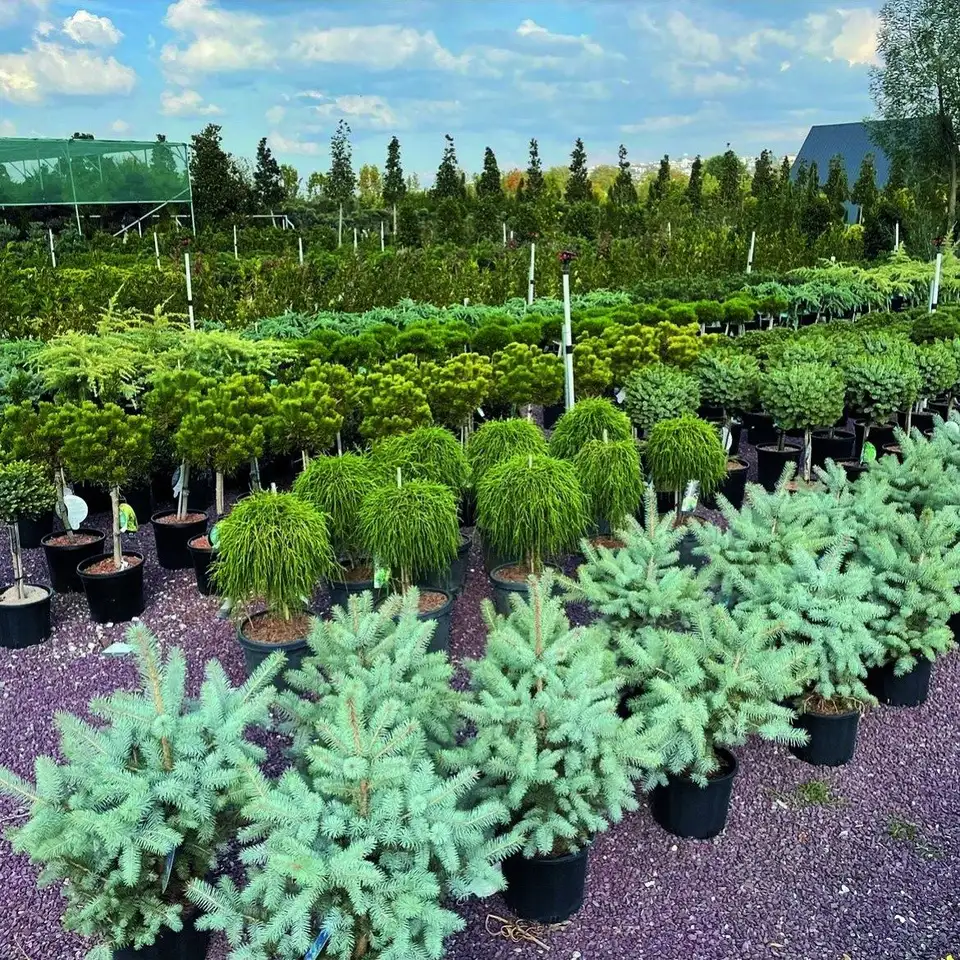
With topiary, early notice matters even more. A spiral or tiered shape takes years to form, so if the design includes them, suitable plants can be earmarked before the project is confirmed.
Every client runs to a different calendar
Contractors and landscape firms
Mostly bulk supply. Plants are split into loads by planting sequence, and each load goes out in the week the site is ready for it. Stock can be reserved ahead for lines where size is critical.
Councils and public bodies
The specification sets out species, girth, height and root ball type, and the quote follows it line by line. Park and verge planting is mostly scheduled for autumn and winter.
Hotels and resorts
Planting usually falls outside the guest season, between November and March. Demand leans towards topiary and specimen trees, and a round of maintenance before opening is often part of the job.
Residential estates and campuses
The initial planting comes first, then upkeep of the shared grounds moves onto an annual programme. Decisions go through a management board, so quotes are itemised and easy to follow.
Buyers outside Türkiye
Our plants have gone to twelve countries: the UK, the Netherlands, Germany, Spain, Italy, Russia, Uzbekistan, Kyrgyzstan, Saudi Arabia, the United Arab Emirates, Qatar and Jordan.
Half of any export job is paperwork. The phytosanitary certificate, the labelling the importing country asks for and the packing list must be ready before dispatch. Some countries set extra rules on soil or growing media, and we go through those before the order is placed.
On a long journey the biggest risk is drying out. Root balls are watered before loading and crowns are covered.
What we cover in a first conversation
Whatever kind of client you are, the first conversation covers much the same ground.
What we'll ask you for
- A plant list: species, quantity, sizes
- Delivery address and lorry access to the site
- Planting date or week
- The specification or planting plan, if there is one
What you'll get from us
- Stock position, line by line
- Which lines will be sourced, and how long they'll take
- Alternative species where a size isn't held
- A delivery plan and number of loads
Working with us
Do you work with private garden owners too?
Yes. We supply private gardens and can plant and maintain them as well. Small orders go through the same checks as large ones.
Can we see a list of references?
We don't publish client names on the website. When we meet, we can talk you through jobs similar to yours.
How does reserving stock work?
Once an order is confirmed, the plants are tagged in your name and taken off sale. The reservation period and delivery date are set out in the quote.
How do we order from abroad?
Send your plant list in English or Turkish. Along with prices, the quote sets out how the load will be packed and which documents will travel with it.
A list is enough to get started
For a small job, a few lines will do; for a large one, send the specification. Whatever you have to hand.