Services
Infrastructure Works
Soil, drainage and irrigation. Work that has to be finished before the plants arrive, and that nobody sees once they have.
When a hedge dies, the cause is usually underground: either the water never arrives, or it never leaves.
Compacted fill, tree pits with no way out for water, shrubs wired to the same valve as the lawn. All of them are expensive to fix after planting and straightforward to get right beforehand.
Groundworks can be part of a landscape installation or a job in their own right, including new drainage or irrigation for an existing garden.
Testing and preparing the soil
It starts with samples. Soil taken from 0–30 cm at several points across the site goes to a lab for pH, texture (the balance of sand, silt and clay), organic matter, lime and salinity. The results show which species will be comfortable there and what the soil needs adding.
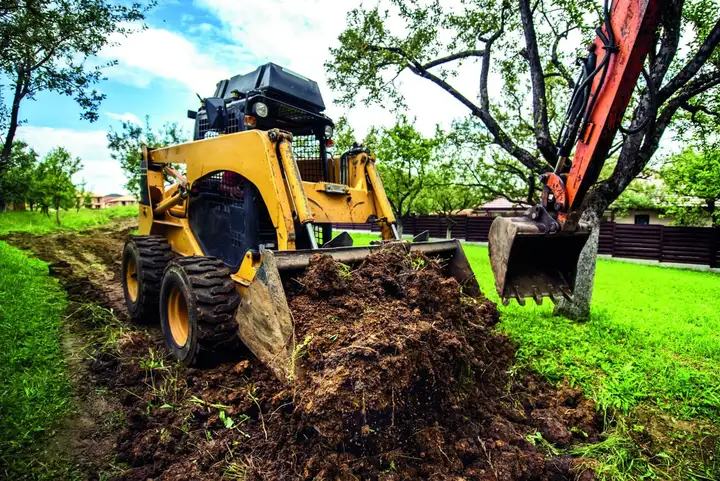
Around new buildings, the ground is often rubble, concrete waste and fill compacted by plant machinery. That layer is removed or broken up by deep ripping, and topsoil is spread on top: 15–20 cm for lawns, 40–50 cm for shrub beds.
Levels fall away from buildings at a minimum of 2%. Even a 1–2 cm dip in a lawn will hold water after rain, which is why the final grading is done with a rake and roller.
Drainage
Three ways to move water
Which one is right depends on whether water sits on the surface or stays in the soil.
Surface drainage
Rainwater is directed before it soaks in: graded falls, channel drains along hard surfaces, shallow swales in lawns. On free-draining soil this is often enough.
Land drains
Perforated pipe wrapped in geotextile is laid in a gravel bed at a 0.5–1% fall and connected to a manhole or the surface water system. Used on heavy clay and where the water table is high.
Gravel trenches
A narrow trench lined with geotextile and filled with coarse gravel, usually with a perforated pipe at the bottom. At the foot of a slope, behind a retaining wall or along a road, it intercepts water coming downhill.
What goes into an automatic irrigation system
Before anything is installed, the pressure and flow rate of the water supply are measured. Those two figures decide how many zones the system can run.
Drip irrigation
- For shrub beds, hedges, tree basins and planters
- Pressure-compensating drippers give even output on slopes
- Filter and pressure regulator at the head of each line
- Laid under mulch or on the soil surface
Rotors and spray heads
- Rotors: large lawns, 8–15 m throw
- Spray heads: narrow strips and small lawns, 2–5 m
- Heads spaced so each one's water reaches the next
- Rotors and sprays never share a zone, as they apply water at different rates
Zoning
- Lawn, shrubs and trees on separate zones
- Sunny and shaded areas kept apart
- Upper and lower levels split on sloping sites
- Each zone on its own valve, housed in a valve box
Controller
- A timer sized to the number of zones
- Rain sensor that skips a cycle after rainfall
- Seasonal adjust: changes every run time by a percentage at once
- Optional remote access and weather-based models

Testing, handover and winter drain-down
Before the pipework is backfilled, the system is held under pressure. A leak found now takes one swing of a spade to fix; found later, it means lifting the lawn.
At handover each zone is run separately, heads are adjusted for arc and throw, and valve positions are marked on a sketch plan. It's the first thing the maintenance team reaches for when tracking down a fault.
Where winters bring frost, the system is drained in November: the main valve is shut, the lines are blown out zone by zone with compressed air, and the controller is switched to its winter setting. We run the irrigation on our own greenhouses and growing fields the same way.
Groundworks: common questions
Can we commission groundworks without buying plants?
Yes. Soil, drainage or irrigation can be a job on its own; planting can be scheduled later as separate work.
How can we tell whether a site needs drainage?
A simple test helps: dig a hole about 30 × 30 cm and 30–40 cm deep and fill it with water. If there's still water in it the next day, don't plant trees until drainage is in.
Drip or sprinklers?
It depends on the planting. Lawns need sprinklers, either rotors or spray heads. For shrubs, hedges, trees and planters, drip uses less water and keeps foliage dry. Most gardens use both, on separate zones.
Can you upgrade an existing irrigation system?
Yes. The old layout is mapped first, then each zone is run and the pressure measured. If the main line is sound it stays; zones are re-split and heads replaced.
Who chooses the controller?
It's chosen with you as part of the project, taking into account the number of zones, a rain sensor and whether you want remote access.
Send us the site dimensions and a few photos
A site plan, details of the water supply or just some photos. We'll suggest a date for the survey from there.