Catalogue
Plant Catalogue
Specimen trees, topiary, shrubs and ground cover are all listed the same way. This page explains what the figures and abbreviations on each line mean.
Every line gives the same five things: species, height, stem, container or root ball, and form.
Species are listed by their Latin names. Common names vary between regions and languages; a Latin name is the only reliable way to know we mean the same plant. The figures that follow describe the plant on the day it leaves the nursery.
A PDF version of the catalogue is being prepared and will be available to download here shortly.
Measurements
Where each measurement is taken
Height
From the surface of the pot or soil to the tip of the leading shoot, given as a range: 200/250 means somewhere between 200 and 250 cm.
Stem diameter
Measured 1 m above ground, in centimetres. Most European catalogues record the girth at the same point instead, written as 16/18. Divide girth by 3.14 for the diameter — a 16/18 tree is roughly 5–6 cm across.
Container size
Volume in litres, prefixed with C. C10 is a 10-litre pot; C110 holds 110 litres. Weight climbs quickly with volume, and anything from C110 upwards goes on by crane or forklift.
Root ball
Field-grown trees are lifted with the soil around their roots, then wrapped in hessian and a wire basket. As a rough guide the ball is ten times the stem diameter: about 60 cm for a 6 cm stem.


Measuring a ball, a cone and a spiral
With topiary, the shape has its own dimensions. A ball is given by its widest diameter: Ø 60. Cones and pyramids have a height and a base width; a spiral, its overall height.
Standards add two more figures: the clear stem height, where the head begins, and the head diameter. Box listed as 'stem 100, head Ø 40' is a 40 cm ball on a metre of straight stem.
Shapes take years. Yew grows 15–25 cm a season and is clipped once or twice a year, so large specimens are always scarcer than small ones.
Three sample lines
The notation follows the format used in European nursery catalogues.
Carpinus betulus · 16/18 · 350/400 · RB
- Species: hornbeam
- 16/18: stem girth of 16–18 cm, 1 m above ground
- 350/400: overall height of 3.5–4 m
- RB: root-balled, lifted from the field and wrapped in hessian and wire
Taxus baccata · ball Ø 60 · C45
- Species: yew
- Ball Ø 60: 60 cm across at the widest point
- C45: grown in a 45-litre container
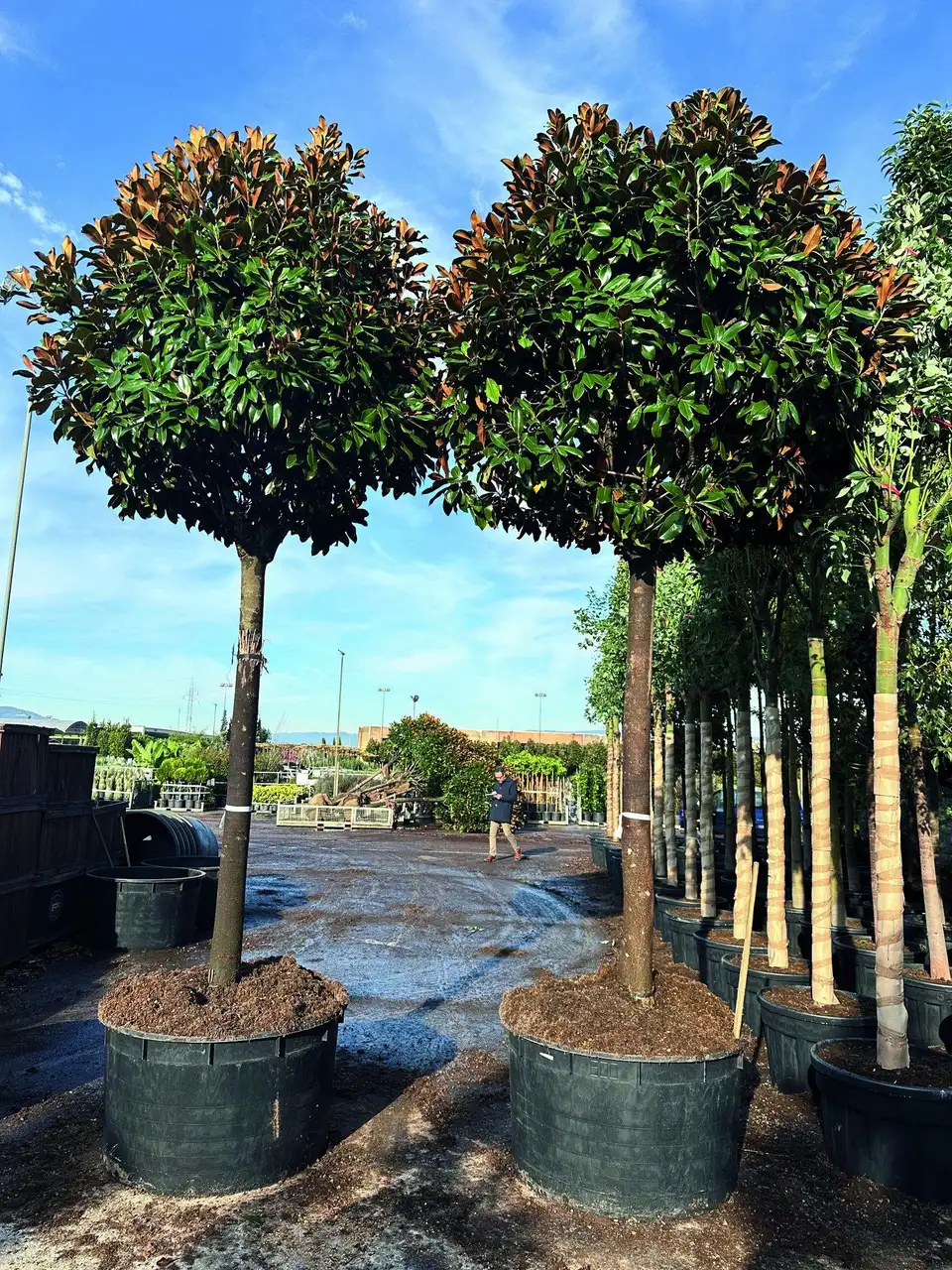
Magnolia grandiflora · standard · stem 180 · C110
- Species: evergreen magnolia
- Standard: a single head on one clear, straight stem
- Stem 180: the head begins 180 cm above the pot
- C110: 110-litre container
Semi-mature or young stock?
A heavier stem looks finished on day one. It also loses a larger share of its roots when lifted, and takes longer to settle in. Within a few years a younger tree has usually closed most of the gap.
Streets and squares need a stem that can take the odd knock, and 18/20 girth or above is a common specification. In a garden, lighter stock tends to establish faster.
Before you order
Will the plants I receive match the catalogue exactly?
Sizes are given as ranges, and every plant we send falls within its range. If you'd rather choose individual trees, book a visit and pick them in the field.
Root-balled or container-grown?
Container plants can go in at any time of year, as long as they are watered through the summer. Root-balled trees are lifted and planted while dormant, between November and March.
What if a species isn't in the catalogue?
Send your list anyway. Species we don't grow ourselves we source from other growers in Türkiye and abroad, and we'll tell you what is available in your sizes and timescale.
Send us your plant list
A table with Latin name, quantity and size is all we need — a spreadsheet, a PDF or a photo of a handwritten list.