Services
Periodic Maintenance
Every month in a garden has its own jobs. Topiary is clipped in June, trees are pruned in February, irrigation lines are drained in November. Do a job at the wrong time and it's either wasted or does harm.
The year at a glance
How a garden's year runs
For a temperate site with lawn, shrubs and trees. Timings can shift by a few weeks depending on location and the year's weather.
Winter · December–February
- Formative and thinning pruning on deciduous trees
- Removing dead, broken and diseased wood
- Winter wash against scale insects and overwintering pests
- Checking topiary for branches splayed by snow
- Checking stakes and ties
Spring · March–May
- Starting up the irrigation and testing it zone by zone
- First feed with a slow-release fertiliser
- Lawn aeration, top dressing and overseeding bare patches
- Weeding and topping up mulch
- Pruning spring-flowering shrubs once they've finished
- Starting checks for box tree moth and aphids
Summer · June–August
- First clip of yew, box and privet
- Lengthening irrigation run times as it heats up
- Weekly mowing at 5–6 cm
- Checking for red spider mite and aphids
- A deep weekly soak for newly planted trees
Autumn · September–November
- Second clip, late August to September
- A potassium-rich autumn feed
- Lawn renovation and seeding, September–October
- Clearing leaves, adding mulch
- November: draining irrigation lines and closing valve boxes


Kinds of pruning
Not every cut has the same purpose, and not every cut belongs in the same month.
Clipping shortens new growth on topiary and hedges. Taxus baccata puts on 15–25 cm a year, so one or two clips are enough. Formative pruning builds the framework of a young tree and is done in winter, while it's bare. Crown thinning takes out crowded and crossing branches, letting light and wind through.
Renovation pruning cuts an overgrown shrub back hard, spread over two or three years. Remedial pruning waits for no season: broken, dead or diseased wood comes out the day it's spotted.
- Cuts are made just outside the branch collar, never through it
- No more than a quarter of the crown is removed in one go
- Secateurs are disinfected after cutting out diseased wood
Feeding, spraying, lawns and water
Feeding
Two main applications a year: a slow-release, nitrogen-based feed in March–April and a potassium-rich autumn feed in September–October. Where there's a soil test, rates follow it.
Pest and disease control
Driven by what we see on each visit. The product is chosen for the specific pest or disease and applied only to affected plants. The winter wash is the one routine exception.
Lawn care
Never more than a third of the leaf blade is taken off in one mow. Aeration and top dressing in spring, overseeding in autumn. Summer watering happens early in the morning.
Irrigation
At the start of the season each zone is run on its own to find blocked drippers, knocked sprinkler heads and leaking valves. Run times are reset in May, July and September.
Getting ready for winter
A job skipped in November tends to come back as a repair in March.
Water left in an irrigation line cracks pipes and valve bodies when it freezes, so lines are blown out with compressed air in November. Newly planted trees get extra mulch over the roots, and evergreens are given one last deep watering before winter.
Heavy snow can force open the middle of a topiary ball or cone. After a snowfall, branches are shaken clear; upright forms can be tied in with twine for the winter if needed.
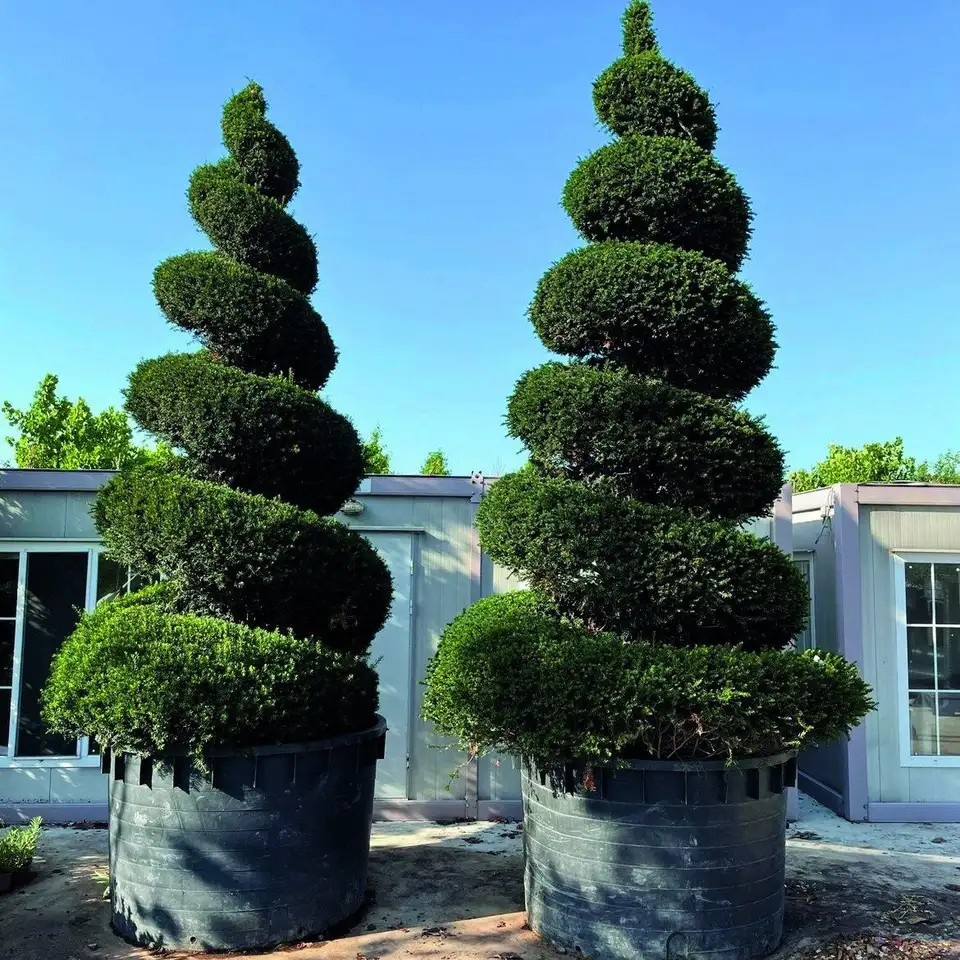
Topiary in its first years after planting
A nursery spiral or ball has taken years of clipping to reach its shape. In its first year in a new spot it gets only a light trim, so it doesn't lose too much foliage while it settles in.
From the second year, two clips a year is normal: in June after the first flush of growth, and again in late August or September. On spirals, the spacing between turns is kept constant each time, checked against a line or template.
The side that gets no sun thins out over time. Topiary in pots is turned a few times a year.
Maintenance: common questions
How often do you visit?
Most programmes run for a year. Visit frequency depends on the size of the site and the planting; visits are more frequent in the growing season and fewer in winter.
Can we book a one-off prune?
Yes. We also come out for single visits: pruning, topiary clipping, feeding or an irrigation check.
Do you look after gardens planted by someone else?
We do. The first visit covers plant health, soil moisture and the irrigation lines, and the programme is based on what we find.
How many times a year should topiary be clipped?
Twice is enough for yew, box and privet: in June and in late August or September. Fast-growing hedges may need a third cut. Nothing is clipped after October, as new growth wouldn't harden off before winter.
What if the irrigation system breaks down?
On sites we maintain, lines, valves and the controller are checked at the start of the season and in midsummer. Any fault we find is repaired as a separate job.
Let's map out your garden's year
Tell us the size of the site, what's planted and how it's watered. After a first visit, we'll suggest an annual programme.