Topiary production: technique and timeline
A practical look at species selection, frames and wire training, pruning schedules, and spiral and ball forms in topiary production, with timelines.
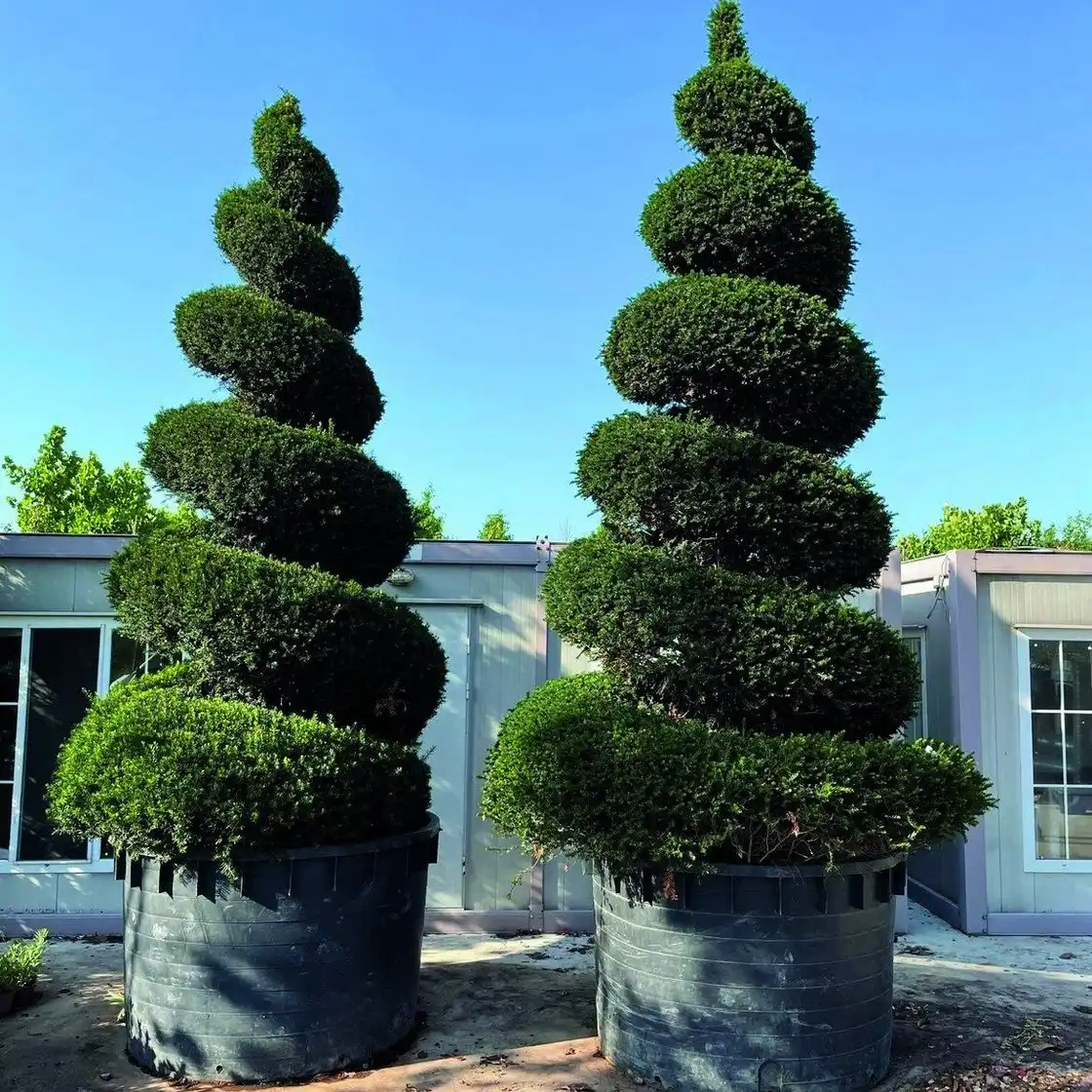
Introduction to topiary production
Topiary is the technique of controlling a plant’s natural growth direction through pruning and supporting frames to give it a geometric or figurative form. It is favoured in landscape projects for entrance points, symmetrical layouts and focal features. Unlike standard nursery production, topiary is a process spread over several years that requires regular intervention, so production planning needs to be right from the start.
Taxus Fidancılık maintains topiary production alongside standard tree and shrub production at its Yalova-based facilities. This article covers the technical aspects of the process, from species selection to pruning schedules, frame use and maintenance requirements.
Species selection criteria
Suitable topiary species have dense foliage, tolerate frequent pruning, and grow at a slow to moderate rate. Fast-growing species need more frequent intervention, raising maintenance costs; very slow-growing species extend the time needed to complete the form.
Commonly used species groups
- Conifers: Yew (Taxus), Italian cypress (Cupressus), Thuja — dense texture, clean cut surface
- Broadleaf evergreens: Laurel (Laurus), pyracantha, ligustrum — quick recovery, glossy foliage
- Compact shrubs: Boxwood (Buxus) — ideal for small-scale forms and low borders
| Species group | Growth rate | Pruning frequency (per growing season) | Suitable form |
|---|---|---|---|
| Yew (Taxus) | Slow | 2 times | Spiral, ball, cone |
| Boxwood (Buxus) | Slow-moderate | 2-3 times | Cube, ball, border |
| Ligustrum | Moderate-fast | 3-4 times | Ball, tiered form |
| Cypress (Cupressus) | Moderate | 2-3 times | Cone, column |
Frame and wire training
For symmetrical forms (spiral, cube, multi-tiered ball), a metal frame or wire skeleton provides a reference line during pruning. The frame is placed around the young plant early in production and the plant is pruned to follow its outline as it grows.
Frame application steps
- Choose a plant with a trunk straightness and thickness suited to the frame size.
- Secure the frame to the soil or container without damaging the root zone.
- Guide new shoots toward the frame surface, supporting them with soft ties if needed.
- Trim branches that extend beyond the frame at regular intervals.
- Gradually loosen or remove the frame as the form matures.
For spiral forms, a reference band wrapped around the trunk can be used for free-hand pruning instead of a wire skeleton, though this requires more experience and time. For ball and cone forms, simple ring frames are usually sufficient.
Pruning schedule and intervention frequency
Pruning timing is set according to the species’ growing season. As a general rule, the main pruning is done when new shoots have half-hardened; light corrective pruning can be repeated throughout the growing season.
Sample annual pruning schedule (temperate climate, based on the Marmara region)
- Mid-spring: post-winter shape correction and removal of dead wood
- Late spring: main form pruning (removing about one-third of new shoot length)
- Midsummer: fine corrective pruning to sharpen the form’s lines
- Early autumn: light correction only (aggressive pruning is avoided before winter)
During periods of intense heat, pruning should be done early in the morning to reduce the risk of sunscald on newly exposed surfaces. In winter, major pruning should be postponed until the risk of frost has passed.
Spiral and ball form techniques
The spiral form is achieved by creating an evenly spaced helical line around the trunk. The critical point in this form is maintaining foliage density on every turn of the spiral; turns cut too thin are easily damaged by sun and wind.
The ball form requires more horizontal and vertical symmetry; checking the plant from four directions (north-south-east-west) during pruning keeps the form growing evenly. In multi-tiered (pom-pom) forms, leaving a clear gap between each tier improves the form’s visual clarity.
Approximate time to complete a form (varies with starting plant size)
| Form type | Estimated time | Critical stage |
|---|---|---|
| Ball (40-60 cm diameter) | 2-3 years | Symmetrical branch distribution |
| Spiral (3-4 turns) | 3-5 years | Maintaining even spiral spacing |
| Cone | 2-4 years | Sharpening the apex |
| Multi-tiered (pom-pom) | 4-6 years | Gap between tiers |
Placement in landscape design
A topiary’s visual impact depends not only on the form itself but on where and how it is used within a project. At entrance gates, along main pathways, and at the focal points of symmetrical layouts, single or paired forms create a strong accent. Along long facade lines, repeating the same form — a row of balls or cones, for example — creates a rhythmic effect.
Points to consider in placement
- Leaving enough distance from surrounding planting and walkways for the form’s final size
- Assessing sun exposure so it supports the form’s symmetrical development
- Preferring more compact forms over fine-detailed ones in spots exposed to a wind corridor
- Avoiding tight spaces that would block maintenance equipment (ladders, shears) from reaching the form
Potted or large-container topiary offers seasonal flexibility for active areas such as terraces and entrances, while ground-planted forms suit more permanent, larger-scale projects.
Maintenance requirements
Topiary plants demand more intensive care than standard landscape plants. Regular watering, balanced fertilising and post-pruning disease monitoring directly affect form quality. For heavily pruned species in particular, cut surfaces should be monitored for fungal infection after each pruning session.
Maintenance checklist
- Clearing fallen leaves and branch debris after pruning
- Maintaining a consistent watering schedule for the first two weeks after cutting
- Applying a balanced fertiliser, not nitrogen-heavy, at the start of the growing season
- Checking that frames and wire ties are not pressing into the plant’s trunk
- Providing cover or windbreak protection before winter in areas with high frost risk
Common mistakes
The most frequent problems in topiary production usually come down to timing and the intensity of intervention. Most of these are predictable and preventable at the production-planning stage.
Pruning too early or too late
Pruning new shoots before they have hardened at all leaves the branch weak and prone to breaking in wind. Conversely, pruning after the shoot has fully hardened means cutting through thicker wood, which leaves larger wound surfaces and a longer healing time. The right timing targets the in-between stage when the shoot is half-hardened.
Overly aggressive single-pass pruning
Removing too much foliage mass in a single session to speed up the form temporarily reduces the plant’s photosynthetic capacity and lengthens recovery time. In slow-growing species especially, this mistake can extend the time needed to mature the form rather than shortening it. Small, regular interventions spread across the season are preferable.
Not loosening the frame in time
As the plant’s trunk thickens, the frame or wire skeleton begins to press against it; if this pressure goes unnoticed, it can leave marks, cause deformation, or damage the bark. Checking frames at least once a season and loosening them when needed removes this risk.
Mismatch between species and form
Not every species suits every form. A fast-growing species with a loose branching habit, for example, may require constant upkeep in a fine-detailed spiral form without ever delivering the expected visual clarity. Form selection should be planned together with species characteristics, comparing species alternatives at the project stage where necessary.
Conclusion
Topiary production is a discipline that delivers predictable results through the right species choice, planned frame use and a disciplined pruning schedule. Because the process spans several years, decisions made early on determine the long-term quality of the form. For project-based topiary requirements, reach us at +90 539 438 29 87 or info@taxustr.com.
Frequently asked questions
How long does it take to complete a spiral form?
Generally between 3 and 6 years, depending on the species used, the starting plant's size and its growth rate. Slower-growing species such as yew can take longer.
Can topiary forms be shaped without a frame?
Small, simple forms can be shaped by free-hand pruning, but symmetrical spirals, cubes or multi-tiered forms benefit from wire or frame guides, which reduce measurement errors and speed up the process.
Related content
-
A species selection guide for landscaping in the Marmara climate
Climate data, wind and salinity exposure, frost risk and soil structure across the Marmara region, with practical guidance on species selection.
-
Landscape infrastructure: drainage and automatic irrigation systems
A technical guide to soil preparation, drainage types, drip and rotor irrigation, hydraulic design measurements and winterisation for landscape projects.
-
Plant health certification and the nursery export process
A practical guide to phytosanitary certificates, root ball and container conditions, labelling, and pallet loading for nursery stock exports.